Sisters' tears for broken family
Arazu has dressed carefully for
her morning flight. The petite, youthful 43-year-old wears summery white
trousers and Jackie O-inspired cream plastic sunglasses. Her nails are
painted deep burgundy and her hair sits in a soft bob above her
shoulders. Her earrings are delicate twisted wire balls with little
pearls buried inside, gifts from her two daughters at Christmastime.
But it's the trousers and sunglasses that carry the most
powerful memories for Arazu. She wore them the day she left Greece with
fake papers more than two years ago. Now, as a legal resident of Europe,
she's wearing them upon her return as a symbol of freedom -- and a
message of hope.
Arazu's flight from Munich lands in the northern coastal city
of Thessaloniki at 1:30 p.m. She waits for the next bus to
Alexandroupolis, which leaves at 4:30 p.m. It is hot and Arazu is giddy
with excitement, despite being unable to sleep the night before.
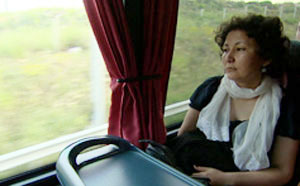
She passes the time in a cafe before boarding for the nearly
four-hour trip. On the bus, she takes a window seat and looks out as
sun-scorched paddocks, herds of goats and corrugated iron shacks sweep
past. Passengers chat, play video games and make phone calls. Arazu just
wants the ride to be over.
In her bag she carries two glittery rings, their gold wash now
dulled, which she intends to put on soon. They were gifts from her
daughters when the family lived in Iran.
Her bag also contains another special pair of earrings. They
are jeweled green frogs that she found in a Munich bazaar. To her, they
represent a saying she likes, that if you "eat the frog" you'll overcome
ugliness with strength.
On this day, Arazu feels very strong.
A family's pain
Earlier this year, we found Arazu
Akhlaqi's daughters sitting on the floor of their temporary home, their
legs curled beneath them and a laptop balanced on the couch at eye
level.
They are waiting for the Skype connection to click in. When it
does, they find themselves looking into the eyes of their mother. Arazu
smiles gently, but her face reveals deep sadness.
This family is in pain. As they talk, the older daughter,
Zahra, leans her head on the shoulder of her sister, Someyeh. The two
girls sink into tears. "I don't want to see you like this," Zahra, 13,
tells her mother.
On the screen, her older brother sits next to Arazu and joins
the conversation: "Don't cry," Yasin, 16, reassures her. But he presses
two fingers to his eyes, stemming his own tears.
"We are always waiting and nothing happens," says Zahra, her
head covered with a purple scarf. "God willing, we will be together,"
her mother answers, squeezing her eyes tight.
Behind Arazu and Yasin's pixelated faces, high on the wall, are
the black, red and yellow stripes of the German flag. It's just a small
sticker planted on a plain gray locker, but it's also a sign of their
separation.
Arazu is in Munich, Germany, with Yasin and her youngest,
8-year-old son Reza. Zahra and Someyeh, 12, are almost 2,000 kilometers
away, in Alexandroupolis, Greece.
Fleeing for their lives
The family is originally from Ghor, a central province in
Afghanistan. Arazu's husband, Mohamed, had been involved in a land
dispute when he was single and was being chased for money. Arazu
believes the people who wanted the cash would have killed him.
Mohamed, fearing for his life, fled to Iran. Arazu stayed
behind with the children but was harassed, blamed for having helped her
husband escape. A year later, she took the children to Iran.
But life in their new home proved grim. Mohamed was working
without papers, and their children were unable to attend school. When a
work argument turned ugly, Mohamed was killed.
In grief and with four children to raise, Arazu decided to
leave, risking everything for the chance to give her children an
education and a new life.
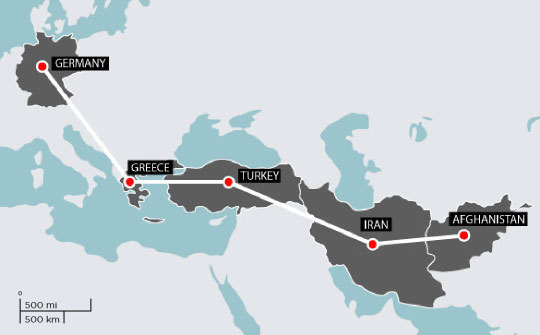
She paid smugglers $5,000 to take her and her sons to Europe.
She left her daughters in the care of a friend until she was safe and
could afford to bring them over. Accompanied by smugglers, Arazu, Yasin
and Reza trekked through Iran and across the mountains of Turkey on
foot, horse and finally by bus into Istanbul, where they spent three
days before crossing into Greece.
They stayed in Athens for a month, searching for someone who
would help them get deeper into Europe. Eventually, a fellow Afghan
created fake documents at a cost of 6,000 euros [$7,840]. Papers in
hand, Arazu and her boys traveled to Germany, where she handed herself
in to authorities and asked for asylum.
As a single mother with two children facing persecution in her
home country, she was accepted as a humanitarian refugee. With that
status comes a one-room apartment, a German passport and an identity
card giving her the right to work. Perhaps more important to Arazu, her
boys could attend school.
According to the Federal Ministry of the Interior, almost
62,000 Afghan citizens live in Germany, a country of just over 80
million people. Last year, just under 30% of the nearly 65,000 asylum
seekers were granted refugee status or another form of protection.
Arazu eventually borrowed 4,000 euros from a friend to pay
smugglers to bring her daughters from Iran to Germany. But they only
made it as far as Greece.
Arazu has not been able to hug her girls for more than two years.
A broken country
Greece is Europe's beggar, a destitute nation surviving on
handouts. Yet for people like Arazu and her children, it is a beacon, an
escape from brutal daily life in war zones and under harsh regimes.
The journey from Afghanistan, Iran and Turkey, over mountains
and across the water to Greece is well-trodden by smugglers and their
human cargo. Those attempting to enter Europe risk their lives. Bodies
are pulled from the waters between Turkey and Greece; others are never
recovered.
Arazu's daughters are among the most vulnerable of the exodus:
children without parents. These children dream of reaching Italy,
Germany or Scandinavian countries.
The reality is usually far grimmer. Thousands are caught in Greece each year.
There are common strands to the stories of immigrant children.
Some parents send their children ahead to establish a life in Europe,
hoping they will eventually bring the whole family over.
Others, like Someyeh and Zahra, try to reach parents and siblings who have already sought asylum.
The Greek state has an obligation to ensure the children are
treated well, placed in the care of nongovernmental organizations and
considered for asylum or reunion with a family member. But the centers
run by NGOs have an open-door policy, and many children simply run away.
The children have little interest in staying in Greece. The
country is broken, the asylum system is troubled and anti-immigrant
sentiment is high.
Social unrest and severe austerity measures are
blamed for the country's increasing violence, and the political far
right has benefited from the discontent.
A teenager's hopes destroyed
Afghan teenage boys are common
travelers, making up a huge exodus from the war-torn country. Ali Reza
Heydari, 17, took off from his home without telling his mother, Europe
on his mind and freedom in his dreams. His family moved from Afghanistan
to Iran when Ali Reza was young. Like the Akhlaqi family, they are
Hazara, an ethnic group that has suffered persecution and discrimination
throughout Afghanistan's history.
The Heydari family settled in Isfahan, a city in central Iran
about 400 kilometers south of the capital, Tehran. Ali Reza's mother is
unwell with diabetes. Ali Reza, having seen his mother fall sick,
dreamed of getting a European passport and becoming a doctor.
Through a translator, Ali Reza told us that living in Iran and
being unable to get an education left him feeling "like a blind person."
For immigrants, school cost around $2,000 a year, and Ali Reza's father
– working as a laborer – could not afford it.
Dreams -- and reality
Ali Reza explained why he left: "I wanted to build my future, I
wanted to continue my education and I wanted to develop. And I thought
it was a way for me." He headed to Tehran, where he contacted smugglers.
Friends had given him their numbers. The smugglers told him: "Don't
worry, it will be OK."
Ali Reza was packed into a truck with 50 other people, in a
space that could fit perhaps a dozen. At one point he was terrified a
friend would die from a lack of oxygen and asked people to give him
space. But then Ali Reza passed out before being awakened by slaps and
punches.
The group was dropped off near the border with Turkey and began
a walk through mountains. "They used to tell us just a little more,
just a little more," Ali Reza recalls of the journey, which he says took
40 hours. They'd been told the walk would take three hours. The
smugglers would "give us a little bread with yogurt, then we would keep
moving."
After crossing the border, the group took a bus into Istanbul.
Ali Reza contacted his parents and asked them for money – the journey
cost $2,000 in total -- so he could pay the smugglers and take the final
leg into Greece. If the children can't find the money, smugglers can
make them work until it's raised.
Ali Reza's group made it to the Evros River, which divides
Turkey from Greece and is a common crossing for immigrants. About a
dozen were piled into a plastic boat designed to carry only a few
people. Two rowers pushed off into the cold April air. Ali Reza said he
was caught on that first trip and sent back to Turkey. But he soon tried
again, and this time he made it.
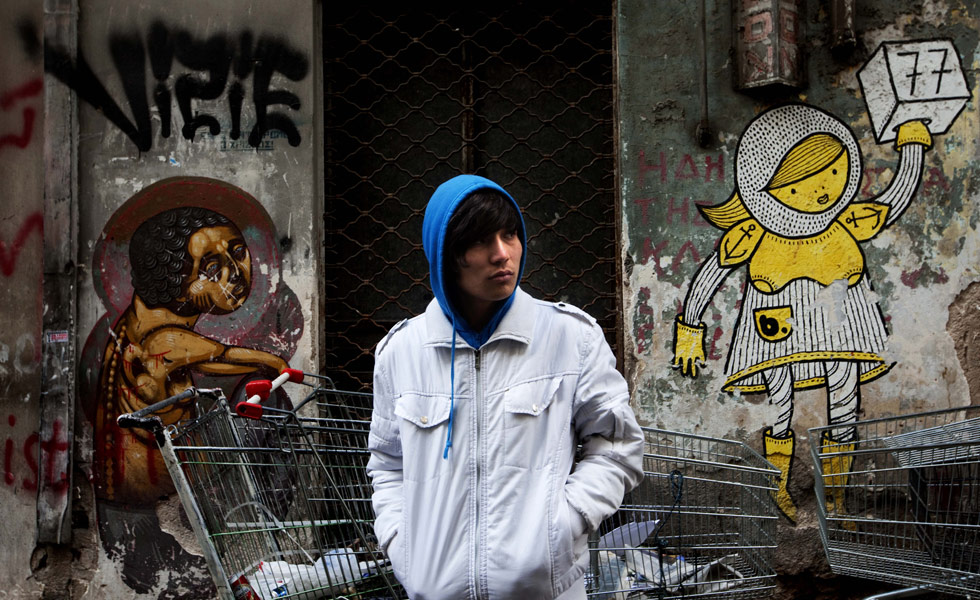
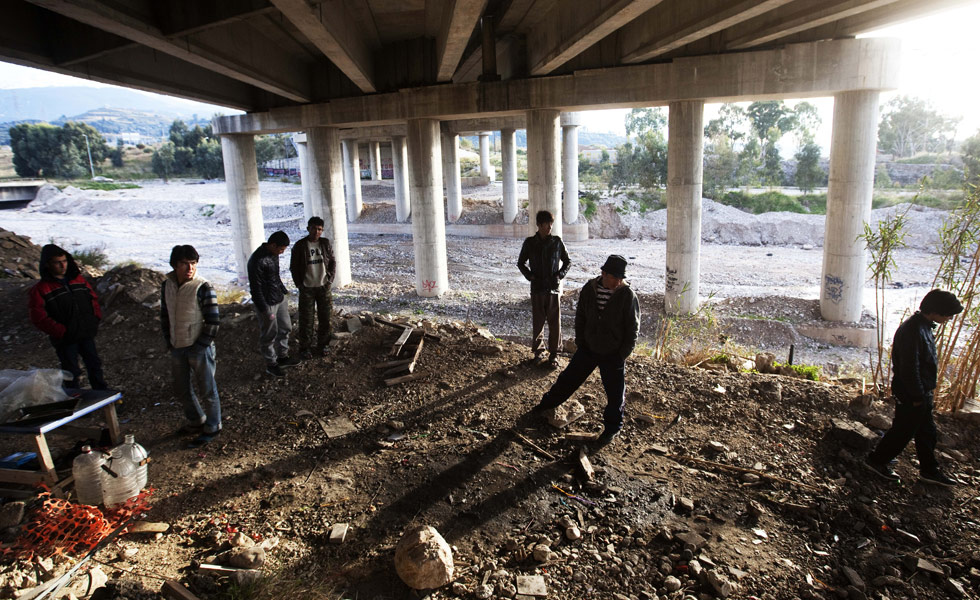
He traveled by train to Athens and set up home in Pedion Areos,
a central Athens park where a street community of migrants lives. He
slept atop a graffiti-laced, concrete-block building and survived on
food from a charity. He had no money. He avoided predatory men who
prowled the park looking for sexual favors. At one point he was beaten
and left with an injured shoulder.
Pedion Areos was "not a safe place," he told us. "Even the
police that are in charge of protecting the people are a danger for us."
Having escaped home, he was now desperate to escape Greece.
A route stalked by death
Ali Reza made it to Europe. So did Arazu and her children. But death stalks this journey, and others aren't so lucky.
A report on unaccompanied minors, published by the Greek
Council for Refugees last year, reveals the brutality of the route.
Families are separated while crossing the borders, and "high numbers" of
children drown in the Evros River or die from hypothermia, the report
found. "Most of their bodies remain unclaimed," it said.
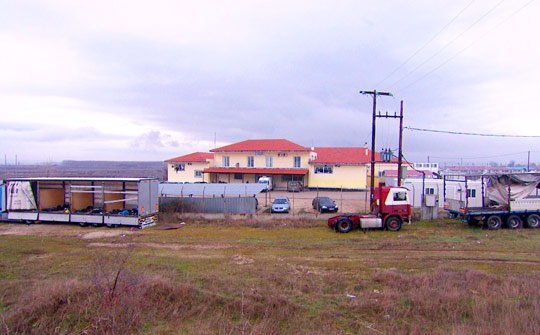
The report focused on the Fylakio detention center, a short
distance as the crow flies from the Turkish border. The council observed
the children's detention conditions between March 2011 and March 2012.
It found overcrowding, a lack of heating and sanitation and limited
natural light made everyday life "literally unbearable."
Some children were forced to lie on the floor with mats in
pools of water or next to leaking sewage. Meals were poor and telephone
access limited, with the strongest children battling their way to the
phones ahead of the weak. The report noted how teenagers escorted
outside after weeks in detention "remain in the shade for their eyes
ache from the sunlight."
Last year, the center was closed for some months and
refurbished. Since then, conditions have improved, police and refugee
advocates say.
We were not allowed inside the center but were given permission
to film the building's squat red-and-yellow exterior, circled by a
barbed-wire fence, from a nearby road under police escort. Here, below
sodden clouds that sweep to the gray horizon of Bulgaria, the barking of
stray dogs in the distance, we observe little movement inside; the
policeman says the inmates are likely asleep.
A hand twitches at the bars of one window; its owner's face is a
pink blob in the dim light. The fingers eventually withdraw and close
the blinds against the world. Fylakio is a grim outpost, but this is
where many immigrants end up. And it's what they want.
Being captured means being registered. The temporary paperwork
this provides gives immigrants the space to figure out the next leg of
their journey. The "pink papers" grant a few days, or weeks, during
which they are legally in Greece. In that time they are expected to seek
asylum, leave the country or seek a family reunion.
Phone calls of hope
Having made it to Munich, Arazu and her sons enjoy a modest
life. Her one-bedroom flat has three single beds pushed up against the
back walls. A bright pink curtain hides the bathroom area and a squat
cooker serves as the kitchen. Arazu knows it's not much, but she's
deeply grateful.
"I love it here," she says. "I am so thankful and appreciative
to the German government. My sons go to school, all the things they
would never have had the opportunity to do."
But grief and stress continue to weigh on her. Last August, as
her boys played in the park while on school holiday, Arazu was worried;
she hadn't heard from her daughters for a week. The girls were in
Turkey, where they had been in and out of detention. They'd get captured
on the streets without papers and detained. They would at times manage
to talk their way out before being captured again.
Arazu had last spoken to her girls on Zahra's birthday. Someyeh
had called and asked her mother if there was a way to celebrate. She
wanted her mom to see if the smugglers would let them play in the park
next door.
Arazu wanted to arrange an additional treat. In Iran, the girls
loved a dessert known as KIM: chocolate-covered ice cream on a stick.
Arazu called an Iranian family she knew in Turkey and asked them to
provide some Turkish lira so her daughters could buy ice cream and nuts
to enjoy in the park. Communication had dropped off since then.
But that bright afternoon in Munich, Arazu's mobile phone rang.
It was Zahra. The girls had finally crossed the Turkish border into
Greece. But they had been caught and held at Fylakio detention center.
Though conditions there had improved since the center was closed for
renovations, the girls were desperately unhappy.
Zahra told her mother she was sleeping on the floor and sharing
a blanket with Someyeh. "This place is no good," Arazu recalls her
saying. "Nobody is looking after us."
Arazu remembered what a friend had told her, that once they
were in Europe her girls would be within reach. "It's a good thing that
you left Turkey," she told Zahra. "You have left Asia and now you are in
Europe." But she knew it wasn't really that easy. She had no money to
reach Greece and would have to fight to get her girls to Germany.
As Zahra spoke, other detainees lined up to use the phone.
Arazu asked Zahra for the phone number so she could call again, but
Zahra didn't know it. Zahra had to hang up before Arazu had a chance to
speak with Someyeh. Unable to reach her daughters again, Arazu could
barely cope. "I waited and waited, but they didn't call me and I was
going crazy," she recalls. "I couldn't sleep at night."
Arazu's worries increased when cooking oil splattered and
burned Reza as his mother was frying potatoes. Arazu tried to take him
to a doctor, but he refused to go; he was still scared from memories of a
doctor's injection in Iran.
In a panic one night, Arazu ended up lost in the streets and
unable to find her way home. She slept on the road before being found
and taken to a hospital for psychiatric treatment. "I was in a hospital
psychiatric ward for 12, or maybe 20 days," Arazu says. "After I left
the hospital, I realized that they weren't going to return my children
to me."
Yasin and Reza had been taken in by Germany's social services.
Two weeks after Arazu left the hospital, and after she had purchased a
small dining table and new clothes to satisfy social workers' requests,
her boys were returned.
Those days are hazy in Arazu's memory. But one moment stands
out. Yasin was visiting Arazu in the hospital, and he passed her the
phone. It was Zahra. They had been released from the detention center.
"I was really happy," Arazu says. "I got better."
After 20 days in Fylakio, Someyeh and Zahra had been picked up
by Arsis, a nongovernmental organization focused on helping young
immigrants. They were taken to Arsis' center in Alexandroupolis, a
coastal city in the Evros region near the Turkish border.
The walls there are adorned with children's artwork that
reveals the trauma of separation. One montage of magazine pictures is
dominated by a cutout of a gun; in the distance a shadowy father figure
reaches out to a child as he walks away.
Someyeh and Zahra began attending a local school -- which the
center's social worker, Ermioni Stamati, says they "love" -- and have
picked up some Greek phrases. They challenge each other in air hockey,
play with a pet baby rabbit that was gifted to them and are putting
together a huge puzzle -- a Picasso, in difficult shades of gray.
Personalized clay pendants they've made are etched with
dreamlike stories reflecting their lives. Someyeh's pendant tells of
going to Germany, where the family will be "very happy" and she can
train to be a nutritionist.
Zahra's tells the story of chicks who lose their mother and are
taken away by a cat. But "her mother comes, tells the cat to go away
and here they are together," Zahra explains, twisting the pendant around
as she tells the story. Zahra looks up as she finishes her tale.
"I don't want to lose my mother," she says. "It's
happened to me. I lose my mother and I hope to be near to her again
very soon."
Brutal reality of immigrant life
Greek and European officials are
working to prevent people like Zahra, Someyeh and others from ever being
able to enter Greece. The European Commission and Frontex, the European
agency that coordinates border control for the region, have allocated
almost 100 million euros to boost Greece's border controls through 2013.
Greece contributes 5% to 30% from its own coffers.
The country has effectively shut off 10.5 kilometers of its
200-kilometer border with Turkey, finishing a barbed-wire fence in
December. It creates an ominous addition to an already grim area, where
Landmine and Cluster Munition Monitor figures show that almost 25,000
antipersonnel mines -- laid by Greek authorities amid tensions with
Turkey in 1974 -- have been cleared since 2009. The fields remain
peppered with anti-vehicle mines.
The fence and the addition of 2,000 border officers a year ago,
backed by Frontex, have proved an effective force in the Evros region.
But closing off one strip can be like "squeezing a balloon," according
to Frontex spokeswoman Ewa Moncure. "It usually tops up somewhere else."
More dangerous routes have already claimed lives. In December,
22 bodies were pulled from the Aegean Sea after a boat sank as it
attempted to ferry immigrants to Lesvos Island from the Turkish coast.
Georgios Salamangas, general police director of East Macedonia
and Thrace, a swath of land that encompasses the Evros region, has been
policing the area for nearly three decades. At his desk in Komotini,
with multiple phones demanding attention, I ask the moustachioed career
cop about the failings outlined in the Greek Council for Refugees'
report on Fylakio. Salamangas details improvements to the center and
says the country "never stops" in its efforts.
When questioned how Greece copes with its status as a
stepping-stone to Europe, he replies firmly that the Greek people "will
succeed." Formal during our filmed interview, Salamangas relaxes once
the camera is off. He is eager to show us footage of border patrols
capturing smugglers after they dump their human cargo on the river's
edge. One clip shows police smashing into a smuggler's boat; Salamangas
looks on with pride. "Greek policeman," he declares.
'Called a Nazi'
Those who do make it into Greece face a volatile atmosphere,
with anti-immigrant sentiment feeding support for the political far
right. Golden Dawn, whose members have adopted the Hitler salute, has
seen its support soar. The party campaigns on an anti-immigration
platform and blames foreigners for rapes, murders and economic woes. It
won 18 parliamentary seats in last year's elections.
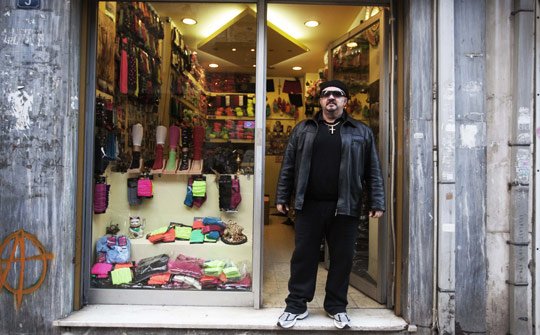
Roberto Chaidi, a stocky man who sits proudly amid the piles of
socks in his eponymous store in central Athens, tells us he is a Golden
Dawn member. His shop is surrounded by the multicultural make-up of
Greece, but he says illegal immigrants do not respect the country's way
of life. Merging cultures, he says, is too hard, asking: "Is it possible
to mix a Chihuahua with a pit bull?"
Golden Dawn has been accused of violence, but Chaidi says the
party is defending the country. "If fighting for my nation means that I
get to be called a Nazi and a racist," he said, "then I am."
His comments are echoed on the streets of Greece. And it is this environment that meets illegal immigrants.
Their numbers are down, yet the people continue to come.
Frontex calculates almost 40,000 illegal immigrants entered Greece, a
country of 11 million, in 2012, compared with 57,000 who breached the
border in 2011 and 55,000 the year before.
A teenager's despair
Nearly three hours' drive from Athens, past the olive groves
and citrus orchards that hug the Peloponnese coastline, is the city of
Patras. It is a magnet for immigrants who attempt to smuggle themselves
onto the ships that slide peacefully out of Patras Port, through the
Ionian Sea and on to Italy.
They live in abandoned blocks and under bridges, surviving by
building tents from street debris and tapping street lights for
electricity.
Ali Reza, who'd made it to Athens from Iran, came to Patras in
his mission to escape Greece but was caught. He took off back to Athens,
where he was taken in by fellow Afghan immigrants, 18 of whom live in a
three-bedroom house. He survived off food from a soup kitchen.
It was a miserable existence, and Ali Reza has had enough. He
plans to return to Afghanistan. He told us authorities had supplied him
with a ticket out of Greece and a promise of 300 euros on his arrival in
Kabul.
The teenager will try to pay smugglers to transport him from
Kabul back into Iran, where he can tend to his sick mother. He will need
to pay them about $1,000.
He spends a final evening with the immigrants who took him in
as one of their own. Ali Reza is so grateful to them that he can barely
find the words. "I wish I had something to give you," he tells them.
"But I have nothing."
He leaves Greece with mixed feelings. "I am getting out of this
situation, leaving these difficulties," he says. "But I am sad because I
could not reach my goals. My future is destroyed."
The next morning, he packs his backpack and walks to Athens'
Syntagma Square to take a bus to the airport. He sells his phone for 30
euros to pay for the 5 euro bus ticket, and he boards with a quick
backward glance at the city.
We've been unable to reach him since.
Struggles -- and success
In Munich, Arazu goes by public transport with a social worker
to a 13-story block and the clinic of Dr. Babrak Kasi. Arazu is here for
DNA testing, requested by the German authorities, to prove links to her
daughters. Kasi, who is also Afghan, chats quietly with her as he swabs
Arazu's mouth.
The Bavarian Refugee Council pays 365 euros for the test, but
the outlay is a struggle for the human rights organization. Arazu is not
in a position to help; as a refugee, she receives 1,000 euros in
benefits to live on each month. She sends 200 euros to the friend who
lent her money to get her daughters into Europe.
In Greece, meanwhile, the girls' social worker at Arsis has
been actively trying to get the family reunited. After months of work,
her lobbying -- along with that of the UNHCR in Germany – has proved
successful. In the end, the DNA test was not needed; the girls have been
approved to be reunited with their mother.
But government funding for programs like Arsis is minimal in
Greece. Stamati, the social worker, has been forced to raise money
through corporate donations and selling homemade goods. She says she's
gone months at a time without pay but loves her job, and continues as
best she can.
The Alexandroupolis office of Arsis now houses 12 children.
Stamati strives to ease their trauma by playing games, putting them into
local schools and teaching them crafts.
And there are moments when all her hard work pays off.
A family's joy
After her flight from Munich and
near four-hour bus ride from Thessaloniki, Arazu arrives outside the
Arsis office, a squat two-story building near the center of
Alexandroupolis. It is dusk, but Arazu waits patiently outdoors for the
signal that it is time to go in.
Zahra and Someyeh have been told they're going to Munich, but
they don't know when -- or that their mother has come to collect them.
Stamati has arranged a goodbye party with local children and
those staying at the center. Cakes, muffins and juice are spread over a
table in the NGO's lounge, and the teenagers have turned the music up
loud. Stamati gathers the crowd for the girls' farewell gift.
"I have a present for you," she tells them. "From all the
children, and from all of us." She hands over a packet of white paper
wrapped in a pink ribbon. The girls unfold it and gaze at the contents.
It takes a few seconds for them to comprehend what it means.
They are holding plane tickets to Munich, departing in two
days. The papers show they will be traveling with their mother. Zahra
collapses onto the floor with a gasp. Someyeh wipes her eyes and looks
up, her face shocked.
Arazu is still standing outdoors. An Arsis interpreter pokes his head out the door and sweeps his arms toward her in excitement.
Arazu enters the building, walks up the marbled white stairs
and turns left into the lounge, bright with music and laughter. She
doesn't make it far. At the doorway, Zahra and Someyeh throw themselves
into her arms.